Status
In Development
Role
Creator, Architecture, Full-Stack Development
Stack
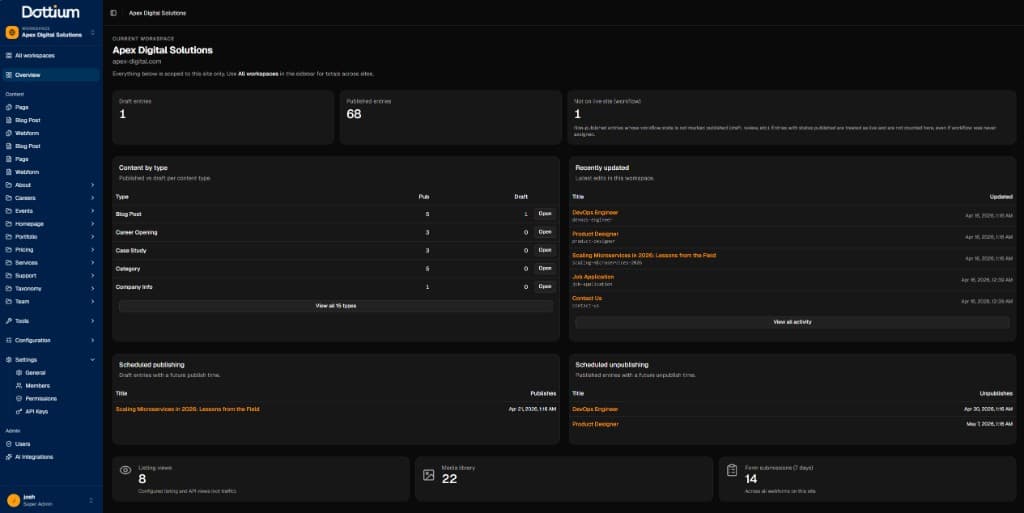
A lightweight headless CMS built for developers and small teams who manage content across multiple websites from a single admin interface.
The Problem
Most CMS platforms are heavy, slow to customize, and painful when you're managing multiple sites. You end up maintaining separate installs, separate logins, and separate content workflows for each project. The tools that do support multi-site are either enterprise-priced or require so much configuration that you spend more time wrangling the CMS than building the actual product.
The Solution
Dottium is a multi-site headless CMS where one admin app manages content for unlimited websites. Content types can be defined in code through a module system or built visually through the admin UI. Everything is served through a REST API that any frontend can consume.
The core idea: the module is the unit of everything. A module bundles content types, saved queries (Views), and lifecycle hooks into a single package. Enable a module for a site and its content types, API endpoints, and behaviors just work. No migrations, no new routes, no manual wiring.
Key Features
Module System
Modules are TypeScript directories that declare content types, views, and hooks as a single package. Four modules ship built-in (Blog, Pages, Taxonomy, Webform), and building a custom module is as simple as defining a content type and registering it in the loader.
Views Engine
A Views engine turns saved query configurations into API endpoints. Define them in code or build them visually in the admin query builder -- pick a content type, choose display fields, add filters and sorts, toggle API exposure. No deploy required.
Content Moderation Workflow
Entries move through configurable workflow states (Draft, Needs Review, In Review, Published) with transition guards that control who can move content between states. Authors can submit for review, but only editors or higher can publish.
Revision History
Every save automatically snapshots the previous state. A field-level diff viewer shows exactly what changed, and any revision can be restored with one click.
Webform Module
Schema-driven forms with a visual builder, submission storage, and optional email notifications. Publish a form to expose it via public endpoints -- no API key required for submissions.
MCP Server
An MCP server (@dottium/mcp-server) lets AI coding assistants like Cursor and Claude Desktop manage content directly. Frontend developers can list content types, read entries, create drafts, and generate TypeScript types without leaving their editor.
URL Aliases
Token-based patterns generate clean paths for content entries. Alias changes automatically create 301 redirects from the old path.
Architecture
The admin UI is built with Next.js App Router and shadcn/ui. Supabase handles the database (Postgres with Row Level Security), authentication, and file storage. The public REST API supports listing, filtering, full-text search, view execution, and alias lookups, all authenticated with per-site API keys.
Roadmap
Dottium is currently used internally for real client projects. The plan is an open-source release (MIT license, free to self-host), followed by Dottium Cloud for teams that don't want to manage infrastructure, and eventually a community module registry.
Tags